

Invisible Family Loyalties: How They Shape Your Adult Life and the Decisions You Make
"What you don’t see still runs your life: Why do you keep repeating stories you never consciously chose?"
It’s really common in therapy to see people repeating a story they don’t actually want to live. A story that doesn’t fulfill them, doesn’t feel like who they truly are, and yet somehow keeps showing up again and again.
People who change jobs, companies, cities, environments, yet somehow end up back in places where they feel unseen, unheard, undervalued, or emotionally drained all over again.
People who genuinely want healthy love, but somehow keep finding themselves in relationships with the same unhealthy dynamics, different faces, same emotional story.
People who try to grow, move forward, improve their finances, or build a fuller life… but something always seems to stop them right before things finally take off.
And eventually, the questions start showing up:
“Why does this keep happening to me?”
“Why is it that even when I change so much on the outside, everything still feels the same inside?”
“Why do I keep repeating something I would never consciously choose?”
And what if it’s not bad luck, lack of ability, or fate?
What if there’s something deeper operating quietly beneath the surface?
What if there are invisible threads shaping your decisions, your relationships, and the way you live… pulling you back, over and over again, into a story you never consciously chose?
You can also read this in spanish:
What Are Invisible Family Loyalties?
When belonging costs you your freedom
Invisible family loyalties are unconscious beliefs, emotional rules, expectations, and survival patterns we inherit from our family system.
They quietly shape the way we love, work, sacrifice, relate, struggle, and even the kind of life we allow ourselves to have.
And most of the time, they don’t look obvious.
They show up as repeated phrases, emotional habits, normalized behaviors, family “truths,” or silent expectations that become so familiar they stop being questioned.
You inherit them without ceremony.
You obey them without realizing it.
I still remember watching my grandmother spend her entire life taking care of everyone else, her nine children, my grandfather, anyone who needed something, while constantly abandoning herself in the process.
And then I watched my mother repeat the exact same pattern:
the caretaker,
the rescuer,
the one who held everyone together except herself.
That’s why I know that unhealthy inner voice so well, the one that spent years telling me my job was to help, fix, carry, and emotionally hold everyone else before even considering my own needs.
The unspoken rule was clear: “Everyone else comes first. And maybe, if there’s anything left, then you matter too.”
That’s also an invisible loyalty.
Family loyalties can shape the way we see money, love, success, responsibility, hard work, sacrifice, what’s “right,” what’s “wrong,” and what’s expected from each person in the family system.
They work like an unconscious script that slowly becomes the lens through which we experience life.
All of those beliefs, phrases, and unspoken rules end up creating an invisible script, a kind of silent law that defines how you’re supposed to love, work, suffer, stay quiet, succeed, or belong within the family clan.
A client I’ll call Marta came to therapy asking:
“Why do I always end up financially and emotionally carrying men who refuse to grow, even though I’m independent, successful, and fully capable on my own?”
After multiple painful relationships and two divorces, she finally started seeing the pattern.It wasn’t “bad luck in love” it was an unconscious loyalty to her mother’s suffering.
Her mother had been abandoned while raising two children alone, and spent years repeating things like: “You need to study and become independent so you never depend on a man.”
Marta followed the script perfectly:
she studied,
became successful,
built stability.
But she also inherited another hidden part of the story:
the role of the woman who carries everything alone.
What looked like strength on the surface had quietly become emotional repetition.
The Invisible Family Script
Imagine for a second that your life is like a play.
It feels like:
you make choices
you choose your path
you create relationships
you decide your future
But underneath many of those choices… there’s an invisible script running in the background.
A script you learned long before you had the awareness to question it. And it’s so deeply wired into you that it feels like truth.
This script doesn’t live only in your conscious memory, it lives in your nervous system, in your automatic reactions, in the way you loves fears chooses overgives disappear, sacrifice yourself.
And why does it stay so powerful?
Because originally, it helped you belong.
Every human being needs:
love
connection
validation
belonging
As children, we quickly learn which behaviors bring us closer to love… and which ones risk losing it.
So we adapt. We become quieter. More helpful. Stronger. Invisible.Responsible.Pleasers.
Eventually, that adaptation stops feeling like a survival strategy and starts feeling like identity.
You no longer think:
“I learned this.”
You think:
“This is just who I am.”
And that’s why breaking free is rarely simple.
Because these patterns exist on multiple levels:
mental
emotional
physical
relational
Which is why they continue operating even when consciously you want to change.
Real freedom begins when you can finally see: the pieces holding the pattern together, why it was created, and the power it still has over the way you experience life and relationships
LEVEL 1: THE FAMILY MANDATE
The first layer of the family script is the mandate: the repeated phrases, emotional rules, and beliefs that slowly shape your identity.
Things like:
“In this family, we sacrifice.”
“Money never lasts.”
“Women here always survive on their own.”
“You have to be good if you want to be loved.”
“Don’t make problems.”
“You always have to stay strong.”

When you hear certain messages repeatedly growing up, they stop sounding like opinions.
They become internal truth.
And eventually, those invisible rules begin shaping: your self-worth, your relationships, your connection to money, your body, success, love, what you believe you deserve.
Ask yourself:
What phrases were repeated constantly in your family?
What beliefs shaped your childhood environment?
What emotional rules did everyone silently follow?
Which ideas still sound like truth inside your head today?
And more importantly: Can you see how those beliefs are still shaping your adult life?
Because sometimes, huge parts of your life story were already being written long before you were old enough to consciously choose anything.
And remember, these loyalties are invisible because they were normalized.
They were built through years of repeated phrases, emotional reactions, silences, expectations, guilt, unspoken rules
So give yourself time to notice them.
This work is not a race.
LEVEL 2: THE INVISIBLE CONTRACT
If the mandate is the message you heard…
the invisible contract is the emotional agreement you made in order to keep belonging.
Most of these loyalties are born from love.
Or from the desperate human need to stay emotionally connected to the family system.
You never consciously “signed” these contracts.
But you still live by them.
Every child arrives vulnerable, dependent, needing love and protection.

So naturally, you learn: what earns affection, what creates approval, what risks rejection.
Maybe you learned:
to stay quiet so nobody gets upset
to be strong so your mother wouldn’t worry
to overachieve to feel worthy
to care for others to deserve love
to suppress your emotions to stay accepted
At the time, these strategies made sense. They helped you survive emotionally.
The problem is when those childhood agreements continue running your adult life.
What once helped you receive love… may now be preventing you from feeling free.
You keep obeying old emotional contracts without realizing it: overgiving, overfunctioning, pleasing, carrying everyone, seeking validation,sacrificing yourself
Ask yourself:
What did your parents expect from you?
How were you expected to behave as a child?
When did you feel the most loved or accepted?
What version of yourself seemed the most accepted within your family?
What kind of adult were you expected to become?
What moral, emotional, or social standards were set in your home?
What did you feel you could lose if you stopped playing that role?
Seeing the invisible contract isn’t about blaming your family.
It’s about understanding what you agreed to in order to belong… and deciding whether you still want to keep paying that emotional price.
LEVEL 3: THE AUTOPILOT PATTERN
This is where the script becomes automatic.
The same emotional songs playing over and over again in adulthood.
You repeat patterns without fully understanding why.In work.Love. Money. Friendships. Self-worth.
At this point, it’s no longer just beliefs.
It becomes instinctive behavior.
Automatic emotional responses learned years ago that still run your life today.

What happens when we grow up and those strategies no longer serve a purpose… yet we continue obeying them anyway?
A client I’ll call Esteban grew up with a mother struggling to survive difficult circumstances on her own.
As a child, he became responsible for his younger siblings.
In that environment, emotions felt dangerous. If he emotionally collapsed, everything collapsed.
So he learned not to feel.
That emotional shutdown helped him survive as a child. But later in life, it turned into panic attacks and anxiety.
That’s how these patterns work:
an old survival strategy being applied to a completely different life.
Ask yourself:
Are there family phrases or beliefs still shaping your decisions?
Are there stories of sacrifice, failure, or lack that seem to repeat themselves through everyone in the family?
Are there decisions you feel you “should” make, even though you don’t really know why?
What pattern do you keep repeating, even though it’s already costing you too much?
Invisible family loyalties can lead you to build a life based on approval, obligation, and constant adaptation, to the point where you lose touch with what you truly want.
A lot of the time, the result is a deep sense of emotional emptiness, inner disconnection, and the feeling that you’re living a life you never consciously chose.
If you want to explore this topic more deeply, you can also read: “Why Does It Feel Like You’re Living a Life You Never Chose?” (click here)
To break free from an invisible loyalty, you first need to look honestly at your current life and recognize which old contracts you’re still unconsciously carrying out on autopilot.
Only then can you make a conscious decision: to cancel that inner contract and begin living in a different direction, instead of continuing to repeat the past.
LEVEL 4: THE PSYCHOLOGICAL COST
The biggest cost of these family loyalties usually isn’t something you can clearly see from the outside.
A lot of the time, it doesn’t show up as some obvious tragedy. It feels more like this constant inner tension, like one part of you wants to move forward, while another part is pulling you back, making sure you don’t drift too far away from the family story.
And that kind of emotional exhaustion is usually really quiet.
It can show up as anxiety that seems to come out of nowhere, guilt when you start growing or doing better, shame around standing out, fear of disappointing people, trouble relaxing, the feeling that you’re never truly deserving, sabotaging yourself when things are finally going well, or that inner voice that never thinks you’re doing enough or being enough.

You may notice inner narratives like:
“If I do better than my family, I’m betraying them.”
“I can’t relax. Life is supposed to be hard.”
“Being fully myself could cost me love.”
“Wanting more is selfish.”
“Good things happen to other people, not me.”
“If I shine too much, I’ll make others uncomfortable.”
“I have to carry everything on my shoulders.”
Over time, these beliefs slowly erode your identity.
You stop asking:
“What do I want?”
And start asking:
“What am I allowed to want?”
That’s where guilt, shame, self-abandonment, and emotional suppression begin taking over.
Ask yourself:
How many times have you struggled to truly be yourself?
How many times have you held yourself back because of fear, guilt, or loyalty?
How many times have you wanted more love, a better job, or a better quality of life… but deep down felt like that kind of life just wasn’t meant for you?
How many times have you made decisions just to avoid upsetting other people?
How many times have you felt like your life doesn’t fully belong to you?
This is where the real work begins: realizing how much it’s costing you to keep molding yourself around an old family pattern built on beliefs, sacrifice, or fear.
Because the things you never question are often the things you keep paying for. And many times, the price is your energy, your peace of mind, your sense of self… and years of your life spent only half-lived.
Signs You Might Be Living From an Invisible Family Loyalty
This isn’t about believing it just because someone tells you to. It’s about looking at your life honestly and asking yourself whether it truly feels like yours.
No one consciously chooses to fail in love, sabotage their finances, repeat painful relationship patterns, or carry more than they can handle. That’s why these patterns are often unconscious — they operate quietly beneath the surface.
Take a look at your life and see if any of these signs show up:
You feel guilty when your life improves.
You keep repeating the same relationship dynamics.
Setting boundaries feels almost impossible.
Resting makes you uncomfortable.
You feel responsible for everyone else.
You normalize self-sacrifice.
You sabotage yourself when things start going well.
Success, love, or visibility feel strangely unsafe.
A client, we’ll call her Marisa, came to therapy wondering why, even though she wanted a relationship, she never seemed able to build one and had spent years alone.
When we looked at her relationship history, a very clear pattern showed up: she almost always chose long-distance relationships, emotionally unavailable men, married men, or relationships that could never fully become real.
Then we explored her family history, and something important came up. Marisa’s mother had been abandoned by her father. And before that, her grandmother had also been left by the man she loved and eventually married someone she didn’t truly want to be with.
The unspoken message in that family was clear: men leave, and women end up alone.
Consciously, Marisa wanted love. But unconsciously, she kept choosing men who could never stay. In a way, she was replaying the family story without having to consciously face it.
As long as she stayed alone, she still belonged to the women in her family system.
Building a healthy relationship meant challenging a very old narrative.
When people keep hitting invisible blocks or repeating the same painful stories over and over again, it’s often one of the clearest signs that an unconscious family loyalty is at play.
Types of Invisible Family Loyalties, And How They Affect Adult Life
These invisible family loyalties don’t always show up in obvious ways. Most of the time, they disguise themselves as virtues, responsibilities, traditions, or just “the normal way to live.”
That’s why they can be so hard to recognize.
And they don’t stay in childhood. They follow you into adulthood and shape your choices, relationships, emotions, finances, and the way you build your life.
A lot of the time, you think you’re choosing freely… when in reality, you’re still responding to an old script.
Here are some of the most common patterns and how they tend to show up.
Sacrifice
This is one of the most rewarded loyalties in many families, and in society too. Giving everything to others, exhausting yourself, putting yourself last, and carrying more than you should is often seen as love, goodness, or strength.
Helping others isn’t the issue. The problem starts when pain, overworking, and suffering become the price you believe you have to pay in order to deserve love or worth.
In many families, suffering for others is valued more than living from joy, freedom, or desire.
It can show up as:
Feeling guilty when you rest.
Feeling like you always have to handle everything.
Choosing relationships where you give way more than you receive.
Confusing love with exhaustion.
Feeling empty when you’re not fixing someone else’s problems.
Over-Caretaking and Saving Others
In some families, one child unconsciously becomes the emotional, practical, or financial caretaker of the entire system.
They become the one who keeps the peace, solves everyone’s problems, manages crises, or emotionally holds the family together. In psychology, this is often called parentification — when a child takes on the role of the parent.
From the outside, it can look like maturity.
From the inside, it often feels like carrying too much too soon.
It can show up as:
Choosing partners or friends who need to be rescued.
Feeling responsible for everyone else’s happiness.
Struggling to receive help.
Chronic exhaustion.
Feeling guilty for prioritizing yourself.
Silence
Silence is one of the strongest agreements within a family system.
“We don’t talk about that.”
“That stays within the family.”
“Better not bring up the past.”
Sometimes it comes from fear, shame, or the need to protect the family image. Other times, it hides abuse, addiction, violence, or deep emotional wounds.
What isn’t spoken about doesn’t disappear.
It gets passed down.
It can show up as:
Staying quiet to avoid conflict.
Tolerating toxic dynamics without addressing them.
Difficulty asking for help.
Carrying painful secrets alone.
Feeling like telling the truth could cost you love.
Scarcity
Scarcity isn’t always about actually lacking money.
Sometimes it becomes an identity.
There are families where having little is romanticized, abundance is distrusted, or success is seen as dangerous or corrupting.
So the person learns to shrink themselves:
“I don’t need much.”
“I’m fine with just a little.”
“That kind of life isn’t for people like us.”
Scarcity can affect finances, emotions, and mindset.
It can show up as:
Charging less than you’re worth.
Fear of growing professionally.
Settling for less in relationships.
Feeling guilty for wanting more.
Self-sabotaging when success finally arrives.
Sometimes the issue isn’t lack of ability. It’s lack of internal permission to thrive.
Money
Money is rarely just about money.
It often carries emotional family history too.
Many people grow up hearing messages like:
“Money is hard to earn.”
“No one in this family ever really succeeds.”
“You have to suffer to make money.”
“If you have too much money, you become a bad person.”
“Better safe than successful.”
When those beliefs operate quietly in the background, people can end up working hard but receiving very little, avoiding opportunities, or feeling guilty when their life improves.
It can show up as:
Fear of charging for your work.
Sabotaging career opportunities.
Overspending as soon as you start saving.
Feeling ashamed of financial success.
Constant feelings of lack, even when you have enough.
Guilt
Guilt is one of the most powerful tools used to keep loyalty within a family system.
Guilt for leaving.
Guilt for growing.
Guilt for having more.
Guilt for setting boundaries.
Guilt for not carrying everyone else.
Sometimes guilt gets confused with love or responsibility.
It can show up as:
Making decisions just to avoid disappointing others.
Pulling yourself back whenever something good happens.
Returning to places that no longer feel good for you.
Anxiety when you prioritize yourself.
Feeling selfish for taking care of your own needs.
A lot of the time, it’s not morality. It’s loyalty in disguise.
Love and Relationships
Romantic relationships are one of the places where invisible loyalties become most obvious.
You may end up repeating the same relationship model you saw growing up, even if consciously you swear you never wanted that kind of love.
If love in your family was connected to sacrifice, abandonment, drama, or emotional deprivation, those dynamics can start to feel familiar.
And many of these relationship patterns begin long before adulthood, especially in the emotional bond with the mother.
Patterns like guilt, over-sacrifice, fear of abandonment, or difficulty setting boundaries are often first learned in that relationship.
You can explore this more deeply in the article “Types of Mothers and Invisible Programming.”
So a healthy relationship may actually feel unfamiliar… while a painful one feels strangely comfortable.
It can show up as:
Choosing emotionally unavailable partners.
Long-distance or impossible relationships.
Carrying the entire relationship emotionally.
Tolerating too much out of fear of being alone.
Confusing intensity with love.
Sabotaging stable relationships.
Relationships often reveal what still hasn’t been healed within the family system.
Unbalanced Relationships
Some families normalize conflict, emotional distance, betrayal, poor communication, or chaos.
When that happens, the person doesn’t consciously want to suffer — but they often end up choosing what feels emotionally familiar.
It can show up as:
Unstable relationships.
Attracting emotionally unavailable people.
Normalizing disrespect.
Addiction to intense but harmful dynamics.
Repeating abandonment, chaos, or infidelity.
Weak or Confusing Boundaries
If setting boundaries was seen as selfish, rebellious, or unloving in your family, chances are you struggle with it today too.
You learned that belonging meant adapting, staying quiet, or pleasing others.
It can show up as:
Saying yes when you really want to say no.
Constantly overextending yourself for others.
Tolerating disrespect or invasions of your space.
Fear of conflict when you try to set limits.
Bottling things up until you explode.
A healthy boundary doesn’t destroy love. It destroys unhealthy fusion.
The Key
Most of these loyalties originally developed as ways to survive, belong, or receive love inside a particular family system.
But what once protected you may now be limiting you.
A lot of what you currently call “my personality” may actually be a strategy you created in order to belong.
Recognizing which loyalty is active in your life is the first step toward stopping the repetition of an old script and beginning to live from conscious choice instead.
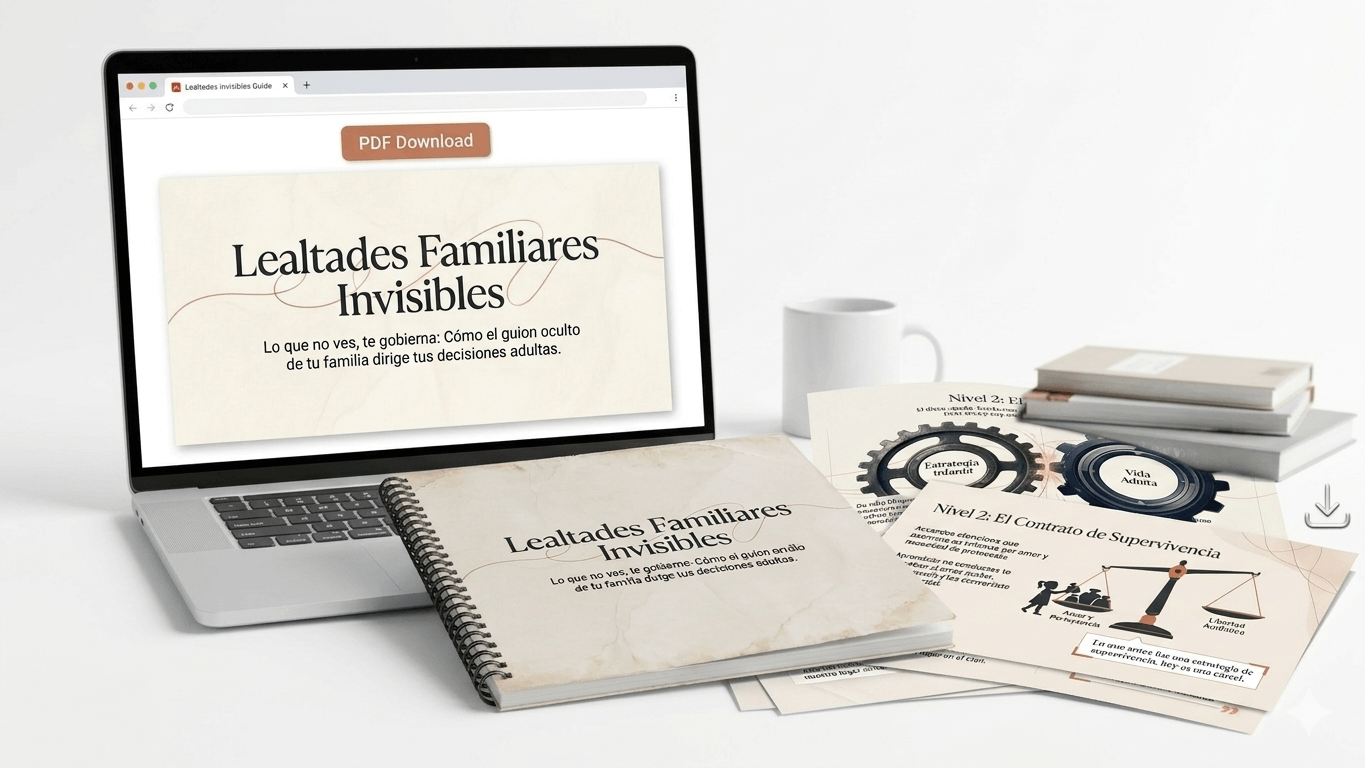
Lealtades Familiares Invisibles PDF
Si quieres reconocer estas lealtades familiares en tu vida puedes hacer clic acá abajo en el siguiente formulario y
Descarga el PDF gratuito
Nombre
Correo
Can Invisible Family Loyalties Be Broken?
Once you can clearly see the script, it starts losing power over you.
And this is where a lot of people get lost because of all the misinformation online and on social media.
Breaking free from invisible family loyalties is not about cutting off your family, rejecting your roots, or blaming your parents or ancestors.
The first step is self-awareness.
Start observing yourself.
Observe your life.
Observe your beliefs.
Pay attention to the automatic patterns running in the background and recognize the psychological cost they’re having on you.
Family loyalties aren’t abstract ideas. They’re real psychological mechanisms that shape the way you make decisions.
As long as you can’t see them, they keep operating automatically.
As long as you can’t name them, they keep deciding for you.
And every family system works differently. Each one has its own wounds, rules, fears, and emotional dynamics.

Personally, I disagree with a lot of what’s currently being promoted online because I’ve seen that it often doesn’t create real change in people’s lives. Many times it just keeps people stuck in circles, wasting time and energy.
For example, all those “ancestral release rituals” or dramatic declarations about “forgiving the bloodline.” Sometimes that’s nothing more than empty spiritual ego disguised as healing.
Healing family loyalties is not about rejecting your family or breaking relationships.
And it’s definitely not about blaming others for unconscious choices you once made out of the desire to belong and be loved.
It’s about recognizing that certain inner agreements no longer serve you, and consciously choosing a different direction for your life.
Think of it like signing a contract or entering a marriage, only to later realize the conditions are unhealthy or not what you expected. The mature thing to do would be to reevaluate, renegotiate, or walk away.
The same applies here.
Freedom comes from becoming aware of what truly works for you and what doesn’t — and then making new choices from that awareness.
Awareness doesn’t destroy belonging.
It destroys emotional slavery.
Therapeutic Support
Breaking family loyalties means stopping life on autopilot and reclaiming your own inner authority.
But many of these patterns run deep, and it’s not always easy to identify them on your own.
In a therapeutic process, it becomes possible to explore these family dynamics with much more clarity.
Book a diagnostic session, and let’s take a look together at what may be shaping your story beneath the surface.
• Privacy Policy • Terms of Service